What Dubuque’s Bee Branch Project Teaches About Resilience
Summary
At the 2026 Forerunner Summit, Dubuque, Iowa, Mayor Brad Cavanagh shared lessons from the Bee Branch Flood Mitigation Project, the largest infrastructure project in the city’s history. His message was that lasting resilience depends on understanding community needs, designing solutions that deliver multiple benefits, and building partnerships that can sustain complex projects over time.
Although Dubuque has been protected from the Mississippi River by a floodwall since the 1960s, flooding remained a persistent problem. Nearly a century ago, the city buried Bee Branch Creek and converted it into a storm sewer, but the undersized system could not handle heavy rainfall. As a result, water regularly overflowed into streets, neighborhoods, and basements. The city experienced six disaster declarations in just over a decade, with estimated damages of $70 million. Between 2005 and 2009, property values in the flood-prone area fell by 6%, even as values across the city rose by 39%.
The Bee Branch project took a different approach, combining community input, thoughtful engineering, and long-term collaboration to address flooding while improving the surrounding neighborhood.
Let the community drive
In 2003, Dubuque formed a committee to consider whether to maintain the underground sewer or restore the creek. Residents chose to bring the waterway back to the surface, establishing the direction for the project.
Mayor Cavanagh emphasized that involving residents early does more than build public support; it gives the community a sense of ownership over the outcome. That engagement helped the city acquire the properties needed for construction without resorting to eminent domain, demonstrating how community involvement can help move complex infrastructure projects forward.
Design for multiple benefits
The city developed a system that slows stormwater runoff, reduces its volume, and safely channels the remaining water through the flood-prone area. Upstream detention basins hold stormwater, while 240 green alleys allow rainwater to soak into the ground. Expanded storm sewers and the restored creek then carry water toward the Mississippi River, where pumps move it over the floodwall.
The investment has delivered measurable results. During a 2017 storm that brought 4.9 inches of rain in less than 24 hours, property owners avoided an estimated $11.6 million in damage. The city also secured $8.4 million for the Bee Branch Healthy Homes program, which provides forgivable loans to repair flood damage and improve home resilience.
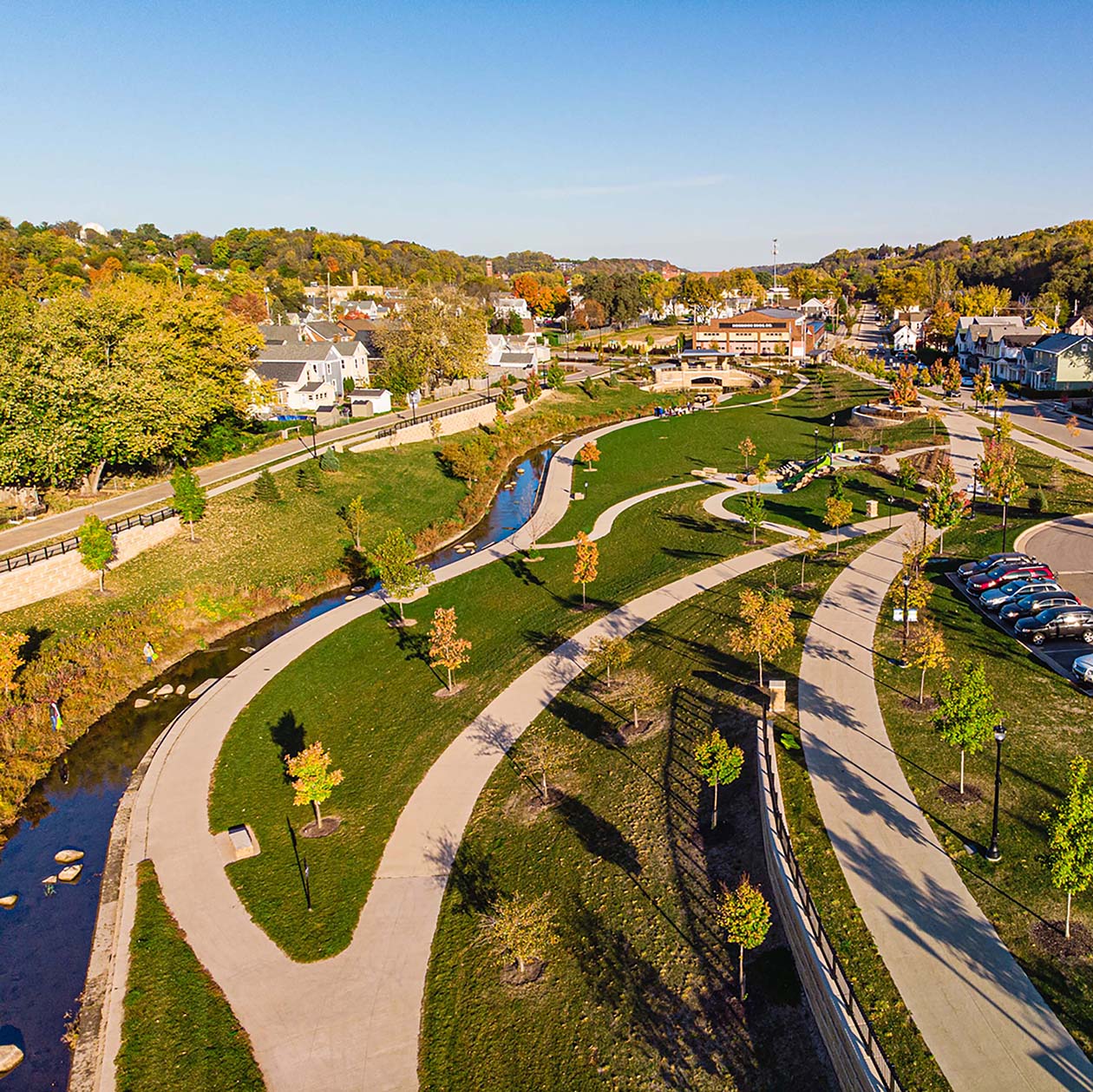
Beyond flood protection, the project created a roughly one-mile linear park featuring multi-use trails, an outdoor classroom, and wildlife habitat. These additions transformed essential flood infrastructure into a community asset while improving the city's resilience.
Partnerships make projects possible
The Bee Branch project required more funding than Dubuque could provide on its own. A dedicated stormwater utility fee established a local funding source, while state and federal grants supported the remaining work. Funding included $129 million in disaster resiliency grants, $16 million in environmental grants, $7.5 million in transportation funding, and more than $2 million in recreation and tourism grants.
Collaboration extended beyond funding. The city worked with the railroad to coordinate drainage improvements beneath its tracks, navigating several years of negotiations to move the project forward. This partnership illustrates how major infrastructure initiatives often depend on aligning the priorities and operations of organizations beyond local government.
Play the long game
Mayor Cavanagh underscored that major resilience projects depend on relationships built well before individual funding decisions or construction milestones. Ongoing partnerships with state and federal agencies help cities navigate complex requirements, secure resources, and advance projects that might otherwise be out of reach.
For local governments investing in resilience or new technology, Dubuque’s experience offers a clear lesson: lasting progress requires more than engineering. By listening to residents, designing infrastructure that delivers broader community benefits, and sustaining partnerships over time, cities can address immediate risks while building stronger, more resilient communities.
Watch Mayor Cavanagh's discussion from the 2026 Forerunner Summit:
FAQ
Ready to see how Forerunner can support your community?
Book a demo