How to Keep Inspection Records Complete Across Multiple Sites
Summary
At operators running inspections across dozens or hundreds of sites or facilities, a gap in the record can easily go undetected. It surfaces at the moment someone asks for documentation, whether that is an internal audit, a client compliance review or an agency request. The inspections were performed, and usually at the required frequency. What is missing is the ability to say with confidence which corrective actions remain open, which were closed, and when.
The gap in the record builds gradually, and most programs have no signal that it is happening. Forms are built, licenses are purchased and crews are trained, and then one site turns out to have no coverage, or the second application requires its own login, or the form takes several minutes to complete at the end of a long walk. Instead of using the designated tool, the team documents the inspection on paper, takes a photo, or emails a note that gets entered into the system days later.
Each of those workarounds leaves part of the record somewhere other than the system the program reports from, so when an auditor, a client or an agency asks for a site's documentation, someone reassembles it from paper, photo libraries and inboxes, and anything that cannot be found is treated as an inspection that did not happen. To an agency, that reads as a compliance finding, and to a client as a question about whether the work under the contract was performed.
What does a site inspection record have to prove?
A site inspection record has to pass four tests. They are worth running against your own program as you read. Take any one site and ask whether its inspection record passes each:
- Exists for every required inspection, at the required frequency, for that site. Most cycles is not every cycle.
- Tied to a place and a time that can be verified without anyone’s recollection. A form dated the day it was submitted rather than the day of the visit fails.
- Shows the condition observed and if a corrective action is necessary, with the follow-up closed out. An item resolved on site but never marked closed is, on paper, still open.
- Can be produced on demand, both to an outside asker and into the system the business runs on, without someone reassembling it from several sources.
The same four tests apply whether the requirement came from a construction general permit, a multi-sector permit, a client contract or an internal EHS standard.
What tools do multi-site operators use to document inspections?
Multi-site operators generally document inspections with one of three categories of tool: a mobile forms product running alongside a GIS or mapping product, an enterprise EHS suite built to track obligations and due dates, or a field intelligence layer that sits on top of those tools and creates the record when the inspection is completed.
Each category handles the four tests differently. The table below runs each test against each type of tool, since the differences between them show up in the field before they show up in a report.
Where do multi-site inspection programs break down?
Multi-site inspection programs break down in four places:
- the same inspection is completed differently at different sites, depending on who is holding the clipboard
- crews go back to paper and manual record keeping
- the form varies from what the permit or standard requires
- sites without cell service produce no record, or a late one
The cost is not the inspection. It is the re-inspection when the first record does not hold up, the rework when a corrective action was never closed, and the staff time spent assembling documentation by hand. Across twenty or two hundred sites, that time becomes a line item in the program budget.
The four tests above are available as a checklist teams can run against their own sites.
Download the multi-site inspection documentation checklist.
Who is asking for inspection records, and how often?
Client compliance reviews, insurer requests and agency inspections increasingly ask for records, and the requests arrive more often than they used to.
The direction across programs, whatever the permit or standard, is toward documentation that can be produced on demand and is expected to be current when it is.
EPA’s proposed 2027 Construction General Permit is one visible instance. Under proposed Part 1.4.1, an operator submitting a Notice of Intent would provide one of three things: the complete SWPPP, a URL where it can be viewed, or the site map plus a signed certification.
Operators outside construction see the same expectation arrive through client audits, insurer documentation requests and industrial stormwater permit inspections rather than a permit rewrite.
What we asked the EPA for
Forerunner filed a public comment on proposed Part 1.4.1 (Docket EPA-HQ-OW-2025-0760). A SWPPP changes throughout a project, so whatever is submitted with the NOI starts to diverge from the plan on site almost immediately. We recommended that EPA not require re-filing on every revision, and instead require any submitted SWPPP material to show its last-revised date and be backed by a record of revisions. We asked that a submitted URL resolve to the current plan rather than an archived copy, stay live for the three-year retention period that already applies to inspection reports and corrective action logs, and sit at a stable, access-controlled location. We also asked EPA to let operators under a group SWPPP reference a single shared submission. Read the full comment.
What does a working inspection program look like?
A working multi-site inspection program is one where the inspection and the record are the same event. The observation, location, time and any corrective action are captured against the site record during the visit, so the documentation for any site exists the moment the visit ends and does not have to be reassembled before it can be shown to anyone.
For the person on site, that means the inspection is finished when they leave. The form they complete is tied to their location, and the photos and the timestamp attach themselves. Open items from the previous visit are already in front of them. Their time goes into inspecting rather than into reconstructing what they inspected.
For the program lead or director, the record is available the moment it is asked for. An auditor, a client or an agency request gets the documentation for a site without anyone assembling a package, and the same record shows which corrective actions are open across every site at once. That view is what makes it possible to see where a program is under strain before a request exposes it, and to plan staffing, training and site coverage from what is actually happening in the field rather than from what was remembered. And because every site is inspected against the same requirements, a finding at one site can be compared with the same finding at another, whoever performed the inspection.
How do multi-site operators close the documentation gap?
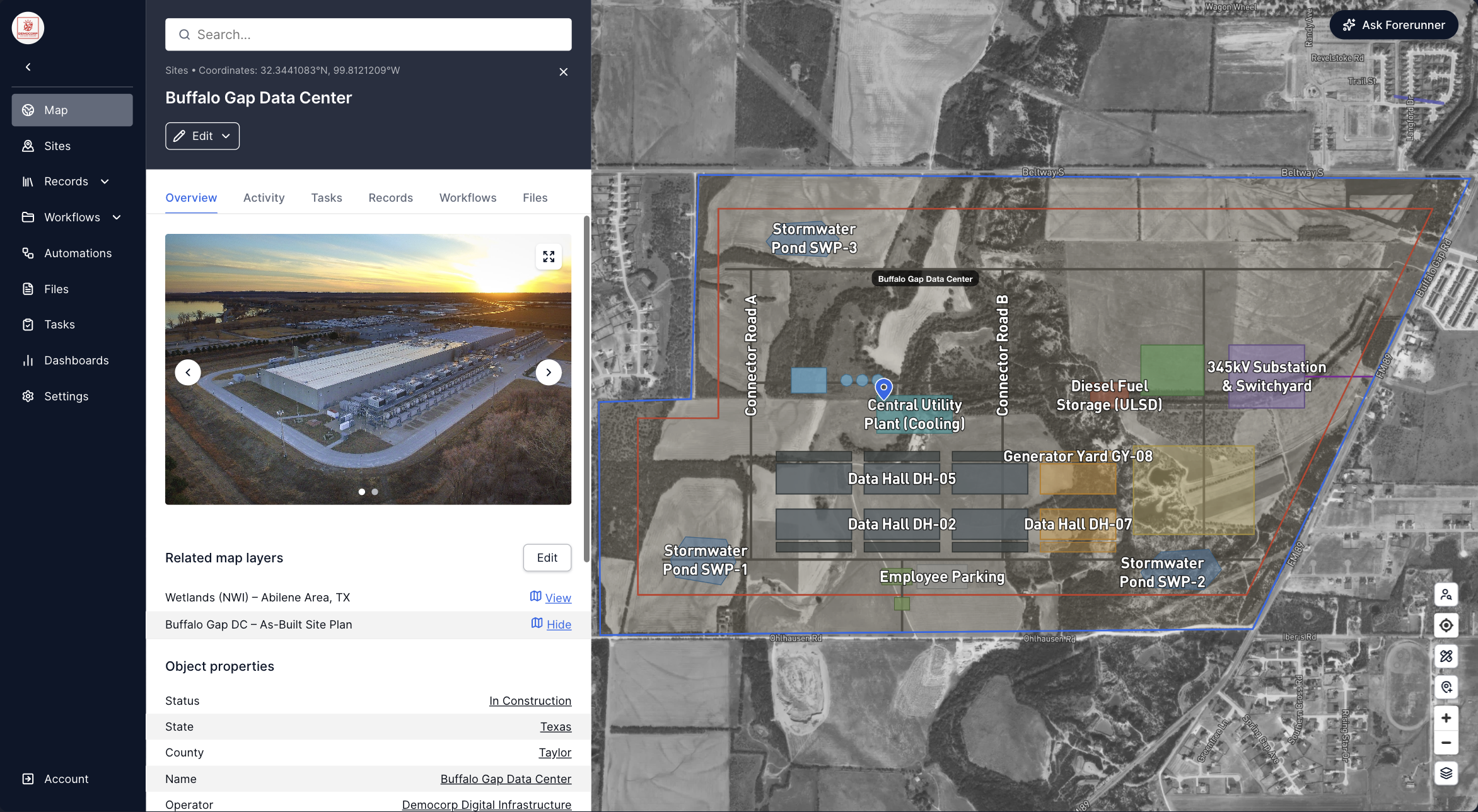
Forerunner is a field intelligence layer for inspections. An inspection system of record holds what the crew captured. Forerunner does that through its mobile app, on site and offline, and it also brings the site's requirements, prior inspections and open items to the inspector while the work is happening, and writes the finished record into the systems the business already runs. Every observation, photo, corrective action and site map from the field lands on a single record, so the documentation for a site is complete when the visit ends and available whenever someone asks for it.
Five things change for the team using it.
- The record is written in the field. The observation, the photo, the location and the time are saved to the site's record during the inspection itself. Nobody has to move a form response afterward or go back in to update a status.
- The inspector sees the history before they start. Previous inspections, open corrective actions, the site map and the requirements for that site are all there before the visit begins, so when someone finds the same problem twice, it shows up as the same problem.
- It works offline. Cell service is usually the first thing to go on a remote site. The whole inspection, photos and location included, is captured on the device and syncs to the site record when service comes back. Nobody types it in a second time.
- The record goes where the business already keeps its records. For most operators that is not only a GIS or an EHS platform. It is the project management system, the CRM or the document repository the rest of the company works out of, and the inspection record shows up there without someone having to carry it over.
- Every inspector works from the same requirements. The permit, the SWPPP and the standards that apply to a site are attached to its inspection record, and Forerunner's AI Assistant draws on those documents when it helps an inspector complete the form, citing the passage it relied on. Photos and voice notes taken on site are turned into field values the same way at every site, so the record reflects the site's requirements rather than the habits of whoever is holding the device.
FAQ
No. A field intelligence layer sits on top of the mapping, EHS and business systems a program already runs. It captures each inspection against the site it belongs to, checks it against that site's requirements, and writes the record back to those systems. The observation, photo, location and corrective action live on the site record, not in a form someone moves afterward.
A field intelligence layer is software that sits between the tools a crew already uses in the field and the systems a business reports from. It captures the inspection where it happens, applies the site's requirements to it, and delivers the finished record to the systems that need it, without replacing any of them.
Not entirely. EPA guidance allows a third party to develop the SWPPP, conduct inspections and corrective actions, and complete reports. The signature has to come from the person who signed the Notice of Intent or a duly authorized representative. The work can be delegated. The certification and the responsibility cannot.
Under the 2022 Construction General Permit, the SWPPP and all documentation the permit requires must be retained for at least three years from the date permit coverage expires or is terminated. The clock starts when coverage ends, not on the last day of work on site.
Some do and some do not, and it is worth confirming before purchase rather than after. Offline capability means the inspection completes in full on the device, including photos and location, and syncs to the record when connectivity returns rather than prompting a re-entry.
It should, and that includes systems that are not compliance tools. Most multi-site operators run a mapping product alongside a CRM, ERP or document repository where finished reports have to end up. The question to ask a vendor is whether the inspection record writes into those systems, or creates a parallel one someone reconciles by hand.
Ready to see how Forerunner can support your community?
Book a demo